
This blog was authored by Yemesrach Workie, Executive Director, International Aid Transparency Initiative (IATI)
As Executive Director of the International Aid Transparency Initiative (IATI), I know that high-quality and timely data on development co-operation is essential for informing decision-making and holding authorities to account. IATI is a global initiative to improve the transparency of development and humanitarian resources and their results.
"I know that high-quality and timely data on development co-operation is essential for informing decision-making and holding authorities to account"
Every day, people all over the world use IATI to track the flow of aid, humanitarian and development resources. Ensuring that this information is high-quality and easily accessible is our greatest responsibility, but we cannot do it alone. It is imperative that development partners do their part through comprehensive, timely, and forward-looking reporting.
Transparency’s Place in the Effectiveness Agenda
In the Busan Partnership for Effective Development Co-operation agreement, governments and development partners agreed to four principles of effective development co-operation: country ownership, focus on results, inclusive partnerships, and transparency and mutual accountability.
Partners agreed that development co-operation is more effective when stakeholders are transparent in their co-operation and hold each other accountable for delivering on mutually agreed outcomes.
Launched in 2008 at the Third High-Level Forum on Aid Effectiveness in Accra, IATI is therefore closely associated with the aid effectiveness agenda alongside the Global Partnership for Effective Development Co-operation (GPEDC).
The GPEDC monitoring exercise promotes collective accountability on effective development co-operation, and transparency is one of the four thematic areas on which it measures progress. IATI is the global standard for publishing open development and humanitarian data. Organisations publish information on their activities and resources using the IATI Standard, and this information is made publicly available through IATI's tools and dashboard, helping improve transparency, coordination, accountability, and development effectiveness.
The Latest Findings on Development Co-operation Transparency
The recently published Making Development Co-operation More Effective Progress Report 2026 includes important insights on the state of global transparency in development co-operation.
"The Global Partnership monitors transparency at the global level by assessing the development partners that reported to the GPEDC monitoring exercise based on their reporting to both IATI and the OECD Creditor Reporting System (CRS)"
The Global Partnership monitors transparency at the global level by assessing the development partners that reported to the GPEDC monitoring exercise based on their reporting to both IATI and the OECD Creditor Reporting System (CRS), recognised in the Busan Partnership agreement for their complementary strengths.
The data[1] suggests that the overall quality of reporting to both global systems remains largely unchanged since the last GPEDC monitoring round in 2018.
The quality of development partner reporting to IATI is evaluated against the dimensions of timeliness, forward-looking and comprehensiveness of the information reported on development co-operation flows, as well as the coverage of reporting to IATI. The good news is that the overall number of development partners reporting to IATI has increased from 58 to 78. Every additional reporting organisation improves the completeness and usefulness of the development data ecosystem.
More comprehensive reporting helps governments and development partners identify gaps, avoid duplication, coordinate interventions more effectively, and hold themselves accountable for the resources they manage. In an increasingly complex development landscape, better visibility across actors is essential for strengthening trust, improving development effectiveness, and ensuring that decisions are based on evidence rather than partial information.
"More comprehensive reporting helps governments and development partners identify gaps, avoid duplication, coordinate interventions more effectively"
For example, Nigeria provides a practical example. The Federal Ministry of Budget and Economic Planning uses IATI data through its Development Cooperation Dashboard to map development partners and their financing against national priorities. This gives the Government and its partners a shared evidence base to identify financing concentrations and gaps, discuss where greater alignment is needed and strengthen co-ordination around national priorities.
In Yemen, IATI data has also become an important source of information on finances particularly during IMF article 4 dialogue which enables wider macroeconomic policy discussions and improve collaboration between the government and development partners.
The less favourable news is that out of the 38 development partners that reported to IATI and participated in the two most recent GPEDC monitoring rounds, only 21% have made progress in improving the quality of reporting, while 29% are in decline. No change is recorded for half of these development partners.
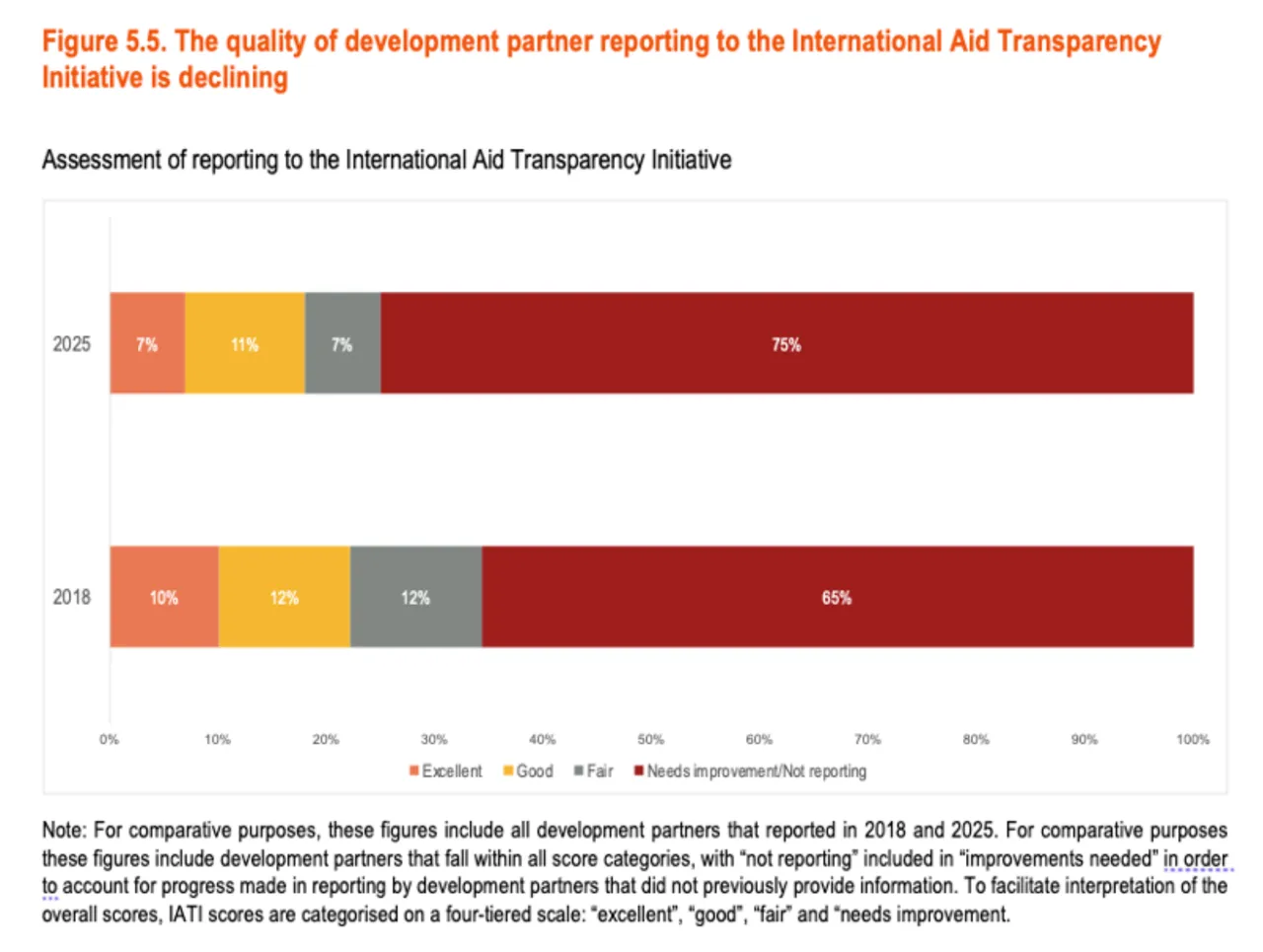
The most notable positive progress has been made on the comprehensiveness of the information reported by development partners. This means partners are completing more data fields that provide vital context to their activities and finances, such as project dates, sectors and locations of activities[2]. This is partially explained by the continued effort to show case data use that incentivized publishers to provide complete information to users.
The lowest scores across the three IATI reporting dimensions pertain to the provision of forward-looking information. This means that there is room for development partners to improve their communication on planned or expected future development and humanitarian spending and activities in the coming two to five years.
This is mirrored by a broader issue highlighted in the Progress Report 2026: The sharing of forward-looking expenditure plans (known as “medium-term predictability”) of development co-operation funding has not improved, with only half of development partners providing partner countries with forward-spending plans covering one, two or three years ahead in 2026, the same as in 2018. The lack of forward-looking information on development co-operation funds can hinder partner countries’ ability to effectively plan and budget for development activities, while also hampering public accountability and the ability to use data for sound decision making.
There are some bright spots: two development partners received a score of excellent in both IATI and CRS assessments in 2025 – the World Food Programme (WFP) and the UN High Commissioner for Refugees (UNHCR). Both organisations publish extensive operational, financial and results information through established reporting systems, demonstrating that even large and complex humanitarian agencies can achieve high standards of transparency.
The Path Forward for Development Co-operation Transparency
The publication of the Progress Report 2026 comes at an important moment for development co-operation transparency, as IATI prepares to launch a new Data Quality Framework later this year.
The new framework will put user needs at the centre of how data quality is assessed, focusing on whether data can be used with confidence. It will assess data across four dimensions: availability (new), coverage (new), timeliness and comprehensiveness.
For development partners, this means:
- Ensuring data is accessible and usable (availability). Before data can inform decisions, users need to be able to access and work with it. The new availability dimension will assess whether IATI data is downloadable, readable and correctly structured.
- Coverage: Providing the full picture of development co-operation financing. The new coverage dimension will estimate how much of a development partner's overall spending is represented in IATI, using authoritative reference data, including OECD Creditor Reporting System (CRS) data where relevant. Development partners are encouraged to consistently report to both the CRS and IATI.
- Timeliness: Publishing data frequently and keep it up to date. Timeliness remains fundamental to effective data use. Across IATI's consultations, partner country governments consistently emphasised the importance of at least quarterly publication, so that information is current enough to support national planning, coordination and monitoring.
- Comprehensiveness: Providing context. Development partners should complete more data fields to provide the context users need to understand their financial and activity data. The new framework strengthens and reorganises this dimension, including by incorporating forward-looking data.
Crucially, IATI’s new data quality framework is intended not simply to assess development partners, but to help them make improvements. IATI is developing a new Data Quality Dashboard that will move beyond a static snapshot or technical score, giving publishers clearer, actionable information on where their data is strong and where improvements are needed.
As this work develops, IATI looks forward to continuing our close collaboration with the GPEDC, whose monitoring plays a vital role in driving progress on transparency and effective development co-operation.
I encourage all those interested to stay connected with IATI as we roll out our new approach to data quality. Head over to IATI Connect, our community discussion forum, to follow the latest updates and join the conversation.
[1] This finding is based on the results of the subset of development partners that reported to the GPEDC as well as IATI and/or CRS. The quality of reporting to the CRS and IATI is evaluated in the following ways:
CRS: The quality of development partner reporting to CRS is evaluated against the dimensions of timeliness, overall quality of the first data submission, completeness and accuracy of the information reported.
IATI: The quality of development partner reporting to IATI is evaluated against the dimensions of timeliness, forward-looking and comprehensiveness of the information reported on development co-operation flows, as well as the coverage of reporting to the IATI.
[2] Comprehensiveness is assessed through the IATI Dashboard based on how consistently publishers provide valid information across three groups of data elements: Core, Financials and Value-Added. These cover essential activity details, financial information and additional contextual information such as locations, documents and results. Core elements receive greater weight in the overall score. More information on IATI Publishing Statistics and the comprehensiveness methodology is available at: https://dashboard.iatistandard.org/publishing-statistics/comprehensiveness-summary/