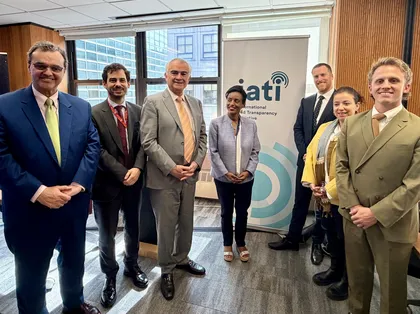
IATI and CAF – Development Bank of Latin America and the Caribbean co-hosted a high-level Transparency Forum during the 81st session of the United Nations General Assembly (UNGA 81). Held at UNDP headquarters in New York on 24 September, the event explored how open data can strengthen trust, accountability and effective global governance.
The Forum brought together representatives from governments, multilateral organisations, development banks and civil society. Discussions focused on improving the quality, accessibility and use of development finance data.
The IATI–CAF Transparency Forum, held during UNGA 81 in New York on 24 Semptember 2026
Strengthening transparency in development cooperation
Opening the Forum, IATI Executive Director Yemesrach Workie described transparency as a “foundation for effective development cooperation”. She highlighted IATI's role in providing a common standard for publishing information on development and humanitarian activities and their financing.
To date, more than 2,000 organisations have published IATI data, covering one million development and humanitarian activities worldwide.
During her remarks, the IATI Executive Director said “publishing information alone is not enough. Data must also be timely, high quality, accessible and useful to those making decisions.”
She also called for greater interoperability between data systems to provide a more comprehensive picture of development finance, including official development assistance, financing from multilateral development banks and South-South cooperation.
Turning transparency commitments into action
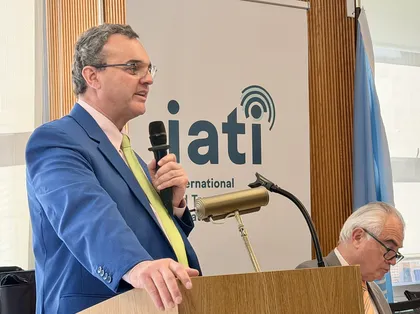
Delivering the keynote address, Pablo Bartol, CAF's Manager of Social and Human Development, shared the bank's experience of strengthening institutional transparency.
Mr. Pablo Bartol, CAF – Development Bank of Latin America and the Caribbean delivered the keynote address
He highlighted the leadership and sustained commitment required to make transparency an integral part of institutional practice. CAF began publishing development finance information using the IATI Standard in 2024. Since then, the bank has published information on more than 280 activities across 14 countries.
During his remarks, Mr. Bartol explained how greater openness can strengthen investor confidence by improving access to information on governance, resource allocation and risk management. He also highlighted the value of international standards and independent assessments in identifying areas for improvement.
From publishing data to demonstrating impact
Moderating the high-level panel, Gary Forster, CEO of Publish What You Fund, highlighted the opportunities created by the growing availability of development finance data.
Drawing on findings from Publish What You Fund’s DFI Transparency Index, he welcomed improvements made by development finance institutions, including CAF. He also identified areas where greater transparency is needed, including project results, evaluations and private sector operations.
Gary Forster emphasised the importance of connecting IATI data with other information sources, including procurement and investment data, to help users better understand how development resources are allocated and what they achieve.
Jesús Rogado of the Spanish Agency for International Development Cooperation (AECID) shared Spain's experience of strengthening transparency across its development cooperation system.
Gary Forster, CEO of Publish What You Fund (left), Jesús Rogado of AECID (centre) and Dima Al-Khatib, Director of UNOSSC (right)
He highlighted Spain's recent decision to join IATI and the launch of AECID's Open Data Portal. The portal enables citizens to explore Spain's development cooperation activities, including projects, funding and implementing partners.
Mr. Rogado explained that transparency is closely connected to open government, citizen participation and strong democratic institutions. He also emphasised the importance of making information available throughout the project cycle, from planning and implementation to monitoring and evaluation. Greater transparency, he noted, should help demonstrate the value and results of development cooperation.
Improving the visibility of South-South cooperation
A central theme of the Forum was the need to better capture the growing scale and diversity of South-South and triangular cooperation.
Dima Al-Khatib, Director of the United Nations Office for South-South Cooperation (UNOSSC), highlighted the expansion of South-South cooperation across sectors, countries and international arrangements.
However, she explained that systems for measuring its contributions and impact have not developed at the same pace.
The Director of UNOSSC also recognised the valuable information already available through existing reporting systems, including IATI. Information on more than 3,000 South-South and triangular cooperation activities has been published to IATI. She highlighted opportunities for greater collaboration between international organisations and data initiatives to improve the visibility, comparability and use of this information.
Making development finance data more accessible through AI
The Transparency Forum also explored how artificial intelligence (AI) can help users access, connect and analyse development finance information.
Kenny Durell of ONE Data presented the Development Finance Observatory, which brings together information on aid, debt, remittances and domestic resources. The initiative uses AI to help users navigate complex datasets and better understand development financing trends.
Kenny Durell highlighted IATI as an important source of timely, structured and machine-readable project-level information. He also highlighted ONE Data's recent membership of IATI, reflecting a shared commitment to making development finance information more accessible and useful.
During the meeting’s open discussion, participants emphasised the importance of strong data foundations for AI applications, including reliable data sources, transparent methodologies and human oversight to support trustworthy analysis.
Building trust through better data
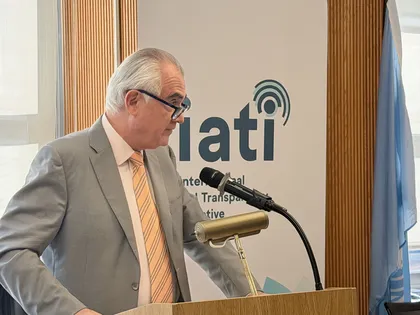
Closing the Forum, José Manuel Salazar-Xirinachs, Executive Secretary of the United Nations Economic Commission for Latin America and the Caribbean (ECLAC), highlighted the importance of data and transparency in strengthening public trust.
José Manuel Salazar-Xirinachs, Executive Secretary of ECLAC, delivered the closing remarks
He emphasised their role in supporting better decisions, allocating limited resources and improving the effectiveness of development cooperation.
The ECLAC Executive Secretary welcomed efforts to improve the visibility of South-South cooperation and recognised the potential of new technologies to connect development finance information. However, he stressed that better data must ultimately contribute to tangible results for people and communities.
The Transparency Forum concluded by highlighting the importance of continued collaboration between governments, multilateral organisations, development banks and civil society.
As the development finance landscape evolves, shared standards and stronger data systems will remain essential to building trust, supporting informed decisions and demonstrating the impact of development cooperation.
IATI extends its sincere thanks to CAF – Development Bank of Latin America and the Caribbean for co-hosting and generously supporting the event at UNGA 81.
IATI Executive Director Yemesrach Workie reflects on the findings of the Global Partnership for Effective Development Co-operation (GPEDC) Progress Report