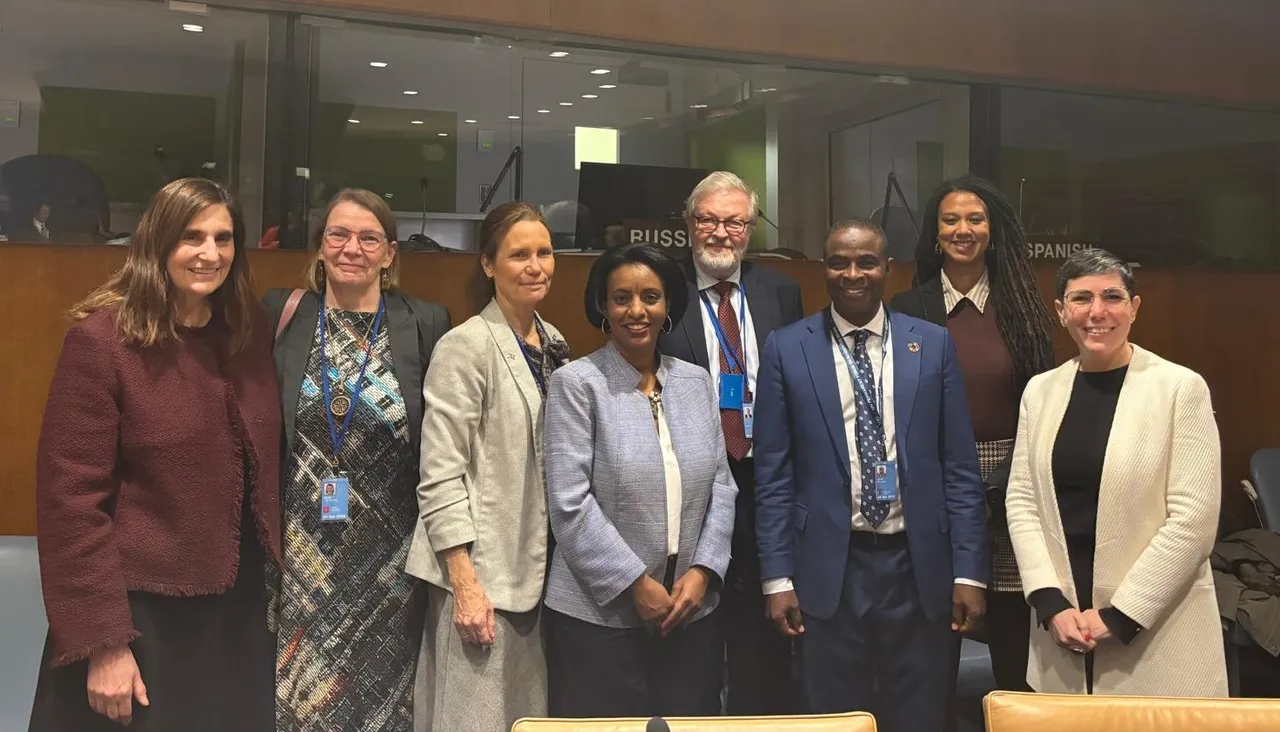
On 22 April, the International Aid Transparency Initiative (IATI) co-hosted a high-level dialogue during the 2026 ECOSOC Forum on Financing for Development Follow-up at United Nations Headquarters in New York.
The session focused on implementing the Sevilla Commitment agreed at the 2025 Fourth International Conference on Financing for Development. It renews the global commitment to strengthening the effectiveness of development cooperation and references key global frameworks and initiatives for their role in advancing the effectiveness agenda.
This event brought together these entities to discuss how to turn commitment into action:
Development Cooperation Forum (DCF)
Global Partnership for Effective Development Co-operation (GPEDC)
OECD Development Assistance Committee (DAC)
International Forum on TOSSD
International Aid Transparency Initiative (IATI)
The discussion focused on how to strengthen the core principles of effective development cooperation, including country ownership by developing countries, alongside strengthened policy coherence by development partners, with a strong focus on results, inclusive partnerships, transparency and mutual accountability.
A system under strain: adapting to a new reality
Providing Opening Remarks, Assistant Secretary-General for Economic Development, Mr. Navid Hanif (UN DESA) described the current strain on development cooperation. He said “Resources are tightening, sovereign debt is rising, and shocks and crises are becoming the new normal. At the same time, needs and expectations are higher than ever—from SDG financing to climate action. This is a stress test for the system.”
Mr. Hanif argued that the current global landscape is exposing the limits of existing approaches in the international architecture, which was originally designed for a more predictable environment. He said: “Can the current system still deliver under pressure, or does it need to fundamentally adapt?”
He reflected that the Sevilla Commitment recognises the role of a revitalised Development Cooperation Forum (DCF) in bringing together partners across the development cooperation architecture, noting: “We are in it together and we have to find solutions together.”
Moderating the panel discussion, Grace Louise Wood, Acting Ambassador to the Economic and Social Council at the UK Mission to the United Nations, emphasised the need to focus on practical solutions and measurable progress.
She also highlighted the UK’s commitment to IATI: “As a founding member and the first to publish to IATI, the UK has always understood the importance of transparent, accessible, and usable data. That is why we will also Chair IATI for the next two years. Data needs to be complete, easily accessible, usable by decision-makers, and interoperable with partner country systems. Without this, we risk failing to ensure development effectiveness”.
From commitments to implementation: closing persistent gaps
The panellists reflected on the gap between agreed principles and real-world implementation. Drawing on the latest evidence, Shari Spiegel (Director, Financing for Sustainable Development Office, UN DESA) highlighted that while the Sevilla Commitment provides a clear framework, progress remains uneven.
She shared a set of priorities emerging from the Sevilla Commitment including stronger alignment with country planning, more predictable multi-year financing, and greater use of national systems rather than parallel approaches. She also referred to the importance of improving information-sharing, strengthening capacity, and enhancing coordination across development partners. Efforts to address fragmentation — including simplifying processes and making better use of multilateral channels — were also identified as important areas for follow-up.
Annika Otterstedt,Assistant Director General, Swedish International Development Co-operation Agency (Sida) and Co-Chair, Global Partnership for Effective Development Co-operation (GPEDC), underscored the importance of mutual accountability and trust as foundations for more effective partnerships. Drawing on ongoing monitoring efforts, she highlighted how country-level data and multi-stakeholder dialogues can help translate global principles into practical reforms and improved coordination on the ground.
Data and interoperability: enabling country-led development
Across the discussion, a strong consensus emerged on the role of data as a foundation for development effectiveness—particularly in enabling country ownership.
Speakers emphasised that improving interoperability between data systems is critical to reducing fragmentation, lowering reporting burdens, and ensuring that data can be meaningfully used within national systems.
Executive Director of IATI, Yemesrach Workie said: “Our work is complementary, but there are also areas of overlap. Unless we better align our efforts, we risk burdening the development system rather than enhancing it”. Ms. Workie emphasised IATI’s role in providing real-time, machine-readable data, forming a critical backbone for the development cooperation data ecosystem.
Asor Henry Nkang, Ministry of Budget and National Planning, Government of Nigeria, demonstrated how integrating IATI data into national systems can directly strengthen coordination and decision-making. Drawing on Nigeria’s experience, he highlighted how real-time data has enabled the tracking of over $7 billion in development finance, supporting more effective alignment of external resources with national priorities.
Ambassador Carsten Staur, Chair of the OECD Development Assistance Committee (DAC), highlighted that the ongoing DAC review is focusing on improving the quality, accessibility and predictability of official development assistance (ODA). He also underscored the need to strengthen country-focused data systems and shared a strong commitment to openness and collaboration across the data ecosystems.
“We have a strong commitment to become more open and more inclusive — to consult, to invite partners into our discussions, and to build the WP-STAT — the statistical working party of the DAC. This includes ongoing work to link IATI and CRS data to enhance transparency, coherence and usability.”
Complementing this, Julia Benn, Head of Secretariat, International Forum on Total Official Support for Sustainable Development (TOSSD), highlighted the importance of capturing the full picture of development finance, noting that data remains fragmented across different systems and providers. She stressed that improving interoperability does not mean creating a single system, but rather ensuring that existing systems can “talk to each other”, reducing duplication and easing the burden on countries.
Julia Benn emphasised TOSSD’s commitment to working with IATI to strengthen interoperability, including through the Sevilla Platform for Action on Bridging Data Systems for Financing for Development to improve coherence and use of development finance data.
Bringing these perspectives together, Eléa Wermelinger, Deputy Head of Department for International Development, Ministry for Europe and Foreign Affairs, France, underscored the urgency of action, noting the $4 trillion SDG financing gap and declining Official Development Assistance. She highlighted France’s G7 Presidency focus on moving from fragmentation toward a stronger partnership and a more coherent, data-driven development architecture. She said “As France assumes the G7 Presidency in 2026, our priority is to move from a mindset of fragmented approach to one of partnership”.
Looking ahead: sustaining momentum on development effectiveness
An open discussion with participants followed, providing an opportunity to reflect on key challenges and priorities emerging from the dialogue.
Looking ahead, speakers emphasised the importance of sustaining momentum in the Financing for Development follow-up process.As global conditions continue to evolve, the ability of the system to adapt, connect, and deliver results will be critical. IATI looks forward to strengthening collaboration with TOSSD, the GPEDC, the OECD DAC and other important actors through the Development Cooperation Forum and the Sevilla Platform for Action.
IATI co-hosted a side-event at the United Nations Third Preparatory Committee for the Fourth International Conference on Financing for Development (FfD4).